On Wednesday, as radiation steadily rose, TEPCO executives tried to obtain permission for their employees to abandon the plant and leave it to the Japanese and US military. The plan was vetoed.
|
|||||
|
Fifty people are risking their lives attempting to work here to save Japan and Asia from massive radiation contamination. This is a sad day for both Japan and the United States, a great alliance. The United States bombed Japan with nuclear weapons, then worked for decades to force nuclear power on its population. Now a US-designed power plant has failed after a natural disaster, and the US urges its citizens to evacuate, leaving millions of Japanese behind. It’s a disgrace. They are completely dry, according to the Chairman of the NRC. This means they are burning, venting into the air through the semi-destroyed building. These rods are normally kept in perpetuity under 20 feet of regularly circulating water. The pool for #3 is “not cooling properly and temperature is rising” says the operator, and “#5 has an unusually large number of fuel rods” stored there, which are now overheating as well. Although the design of the reactors now in trouble in Japan was a subject of controversy since at least 1972 when a ban was considered in the US, here is a reminder that the controversy has continued ever since.
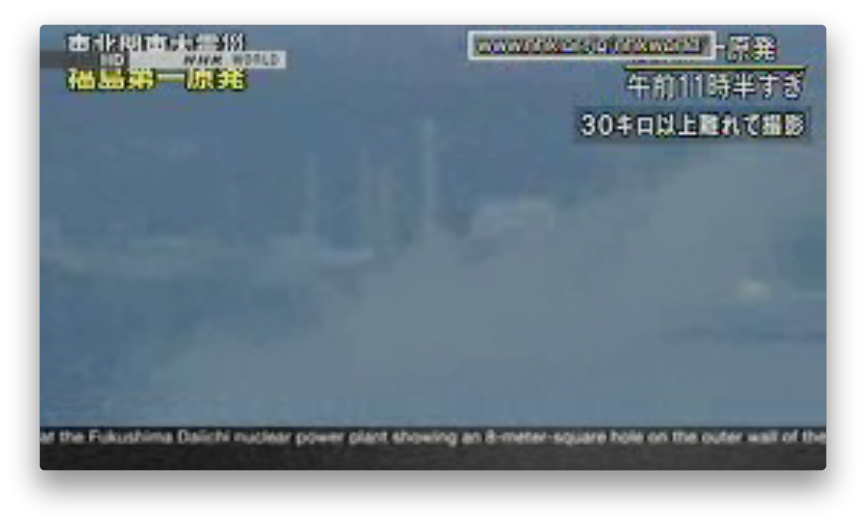
How bad is it? Workers are trapped inside the control room, the most heavily shielded place in the complex. A helicopter flight over the plant to desperately drop water on burning, radiation-spewing fuel rods was aborted due to high levels of radiation detected in the air above the plant. A regulation has been changed, upping by 2.5 times the limit of radiation exposure the workers will be allowed. The Emperor of Japan addressed the nation about a disaster for the first time in his life. He is 77 years old. UPDATE: The statement by the Chief Cabinet Minister that the #3 reactor vessel was damaged has been retracted. If it’s true that the vessel is intact, this is relatively good news if only a minor relief. It’s now speculated that the smoke coming from reactor #3 is from overheated spent fuel rods. While still terrible, a hole anywhere in the #3 vessel would be worse. Apparently fuel rods are still burning atop one or more reactors at the Fukushima Daiichi nuclear power plant. Japanese Chief Cabinet Secretary says that the smoke is coming from the #3 reactor and they don’t know why. He said “the most likely case” is that this is radioactive gas coming from inside the reactor. It is now up to 50 workers, who have already been overexposed to radioactivity, to stop 3 nuclear meltdowns. “Radiation has spread from these reactors and the reading is VERY HIGH” – live http://www.ustream.tv/channel/nhk-world-tv The Prime Minister of Japan has just called (at 9:04PM CDT) that people evacuate a 20km area around Fukushima’s second nuclear plant, the one so far not covered in the news media. He admits that “Reactor #4” is on fire. He’s called for calm among the Japanese people. He mentioned 3 specific reactors, but took exactly one question, where he was asked why he did not address the reactor that exploded 4-5 hours ago. He refused to answer. UPDATE: An official admits a 4th hydrogen explosion at the site, at what he describes as #4 reactor. “Radioactive substances are being released” by the fire. “The radioactive substances are coming out from the #4 reactor” It has become obvious that a third explosion has occurred and that it is impossible to cool this reactor (named Unit #2 at Fukushima Daiichi nuclear plant in northern Japan). This makes the accident second only to Chernobyl and may well go beyond that level of radiation release. At this hour three reactors are out of control.
|
|||||
|
Copyright © 2026 narus.info PRISM/US-984XN - All Rights Reserved Powered by WordPress & Atahualpa |
|||||